Keeping materials apart to reduce corrosion risk
Corrosion affecting steel bathtubs remains a recurring concern. The precise combination of materials, moisture and installation conditions responsible for individual cases of corrosion has yet to be conclusively established. This raises an important practical question about bathtub installation: what role can bath cladding play, in keeping steel bathtubs separate from cement-based building materials?
By Markus Wittlerbäumer, Head of Application Technology, wedi Group
Understanding the corrosion risk Following the expert event in Fulda and the in Fulda and the publication of an article on corrosion damage to baths in the German trade journal F+P Fliesen und Platten (issue 9/2025), industry specialists have reported isolated cases of corrosion affecting steel bathtubs where cement-based mortars used for tiling come into contact with the outer surface or rim of the tub.
This can lead to chipping or flaking of the protective coating, rust spots and, in severe cases, corrosion that penetrates the steel. However, such cases remain rare considering the large number of steel bathtubs installed, and no definitive cause has yet been established. Several factors may be contributing to the problem, including defects in or damage to the protective coating, direct contact with mortar, moisture acting as an electrolyte, prolonged drying times and the specific composition of the materials involved. Whether the decisive factor is the fixing mortar, the tub's protective coating or the interaction between these under particular site conditions remains unclear.
From a practical perspective, this uncertainty is no reason to delay taking precautions. Instead, it reinforces the need to prevent direct contact between these materials through careful design from the outset. One experienced tiling professional summed up the issue with a simple question: "Why should tile adhesive come into direct contact with the steel tub at all?"
What is bath cladding designed to do?
The answer lies in understanding the different roles of the tub and its cladding. A correctly installed bathtub relies on a purpose-designed support system for its stability, whether bath legs, a bath carrier or other mounting components. The side cladding is not intended to provide structural support for the tub itself. Instead, it provides a level, stable surface for tiling, conceals plumbing services and allows the required shape and finish to be achieved.
Put simply: the cladding supports the tiles, not the tub. When this distinction is taken into account from the outset, the cladding does not need to be of solid construction or bear directly against the steel tub. This creates opportunities for installation solutions that minimise direct contact between materials, particularly where plumbing and tiling work meet.
Where traditional bath construction can pose a risk
Bath surrounds are often constructed using aerated concrete blocks or other mineral-based building materials. The blocks are bonded with thin-bed mortar before the structure is tiled. This is a well-established method and is not inherently problematic. However, one particular installation detail requires careful consideration. If the blocks or mortar extend right up to unprotected areas of the steel tub, metal can come into direct contact with alkaline cement-based materials in the presence of moisture. Cement-based materials can absorb moisture during construction and retain it for some time. Condensation or additional moisture introduced during building work can also contribute. These conditions alone do not necessarily lead to corrosion. Where the protective coating is intact and continuous, with no exposed steel, corrosion would not normally occur simply as a result of this contact. However, where the coating is damaged or areas of steel are left unprotected, prolonged contact with moisture can increase the risk. This is why careful detailing around the tub rim is particularly important, alongside the choice of materials.
An alternative approach to bath cladding
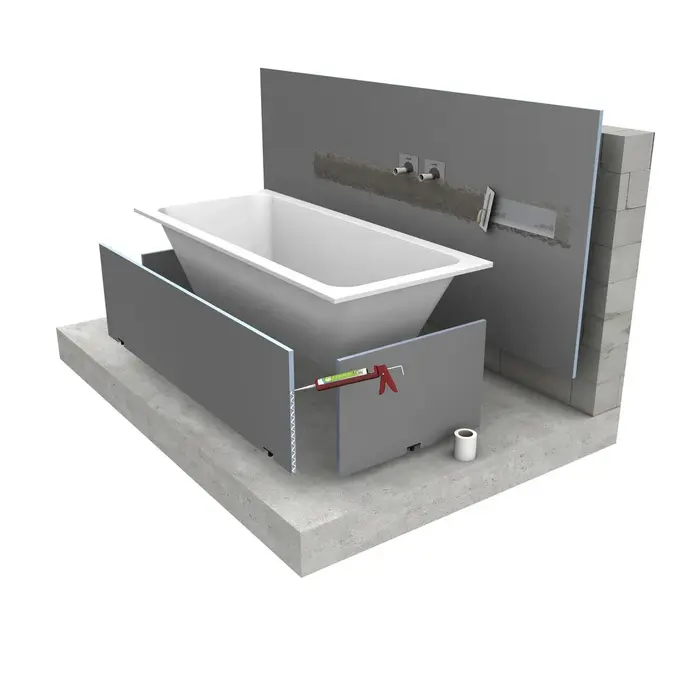
Prefabricated bath cladding made from XPS building boards offers an alternative to traditional blockwork. The XPS core does not absorb water by capillary action, while the boards are coated on both sides and can be tiled directly. There is no need for masonry to form the cladding, resulting in a lightweight, slimline construction that is easy to cut and shape. With the 20 mm-thick wedi Bathboard, for example, the height can be adjusted using levelling feet. This allows uneven floors to be accommodated without the need for additional masonry work. The cladding can be fixed to the rim of the steel tub using a suitable adhesive sealant,
without the need for cement-based mortar to come into contact with the steel. Tile adhesive is applied only to the designated board surface. The space-saving construction is particularly useful where tub rims are narrow or space is limited around taps and other fittings. Cut-outs can easily be made on site, and an access opening can also be incorporated into the cladding if required at a later stage. Whether access for inspection or maintenance is needed from the outset depends on the bath waste fitting, the installation design and the relevant manufacturers’ requirements.
Masonry bath surrounds also require careful detailing
This does not mean that masonry bath surrounds should be ruled out altogether. Where mineral-based building materials are used, direct contact between steel tub and cement-based materials should be prevented over the long term. One option is to incorporate a suitable, continuous separation layer. The choice of separation layer and how it is fitted where it meets the tub must be checked against the tub manufacturer's installation and waterproofing requirements, as well as those of the chosen system.
Equally important are an undamaged tub surface, properly detailed junctions and a carefully coordinated process. Any damage sustained during transport or installation must not be concealed by subsequent work. Damp materials must also be given sufficient time and suitable conditions to dry. Before the cladding is closed up, plumbing and tiling contractors should agree who is responsible for detailing the tub rim, waterproofing, sound insulation and, where necessary, providing access for future inspection or maintenance.
Practical checklist before fitting the bath cladding
- Install the tub in accordance with the manufacturer's instructions and check for any damage.
- Avoid direct contact between the steel tub and cement-based building materials.
- Where mineral-based are used for the bath surround, incorporate a suitable, durable separation layer.
- Coordinate sealing around the tub rim, sound insulation and fixings as part of the installation design.
- Allow for sufficient drying time, and take account of moisture introduced during building work.
- Confirm in advance whether access for future inspection or maintenance is required and, if so, where it should be positioned.
Conclusion
Until the precise cause of these rare cases corrosion has been conclusively established, careful construction detailing remains essential. Above all, the priority is to prevent direct contact between the steel tub and cement-based building materials. Where cement-based materials are kept separate from the steel tub and moisture is not allowed to remain at the interface for prolonged periods, significant risk factors are eliminated. XPS-based bath cladding offers a practical way to achieve this, using relatively little material and keeping installation straightforward. However, it is not a substitute for correct tub installation, proper waterproofing or appropriate detailing around the tub rim. Its role is to provide a secure, durable substrate for tiling.


